
Friction force
Definition of friction
Friction is the force resisting the relative motion of solid surfaces, fluid layers, and material elements sliding against each other. Frictional forces, such as the traction needed to walk without slipping, may be beneficial, but they also present a great measure of opposition to the motion.
Explanation
The amount of friction depends on the materials from which the two surfaces are made. The rougher the surface, the more friction is produced. Friction also produces heat. If you rub your hands together quickly, you will feel them get warmer.
Friction can be a useful force because it prevents our shoes from slipping on the pavement when we walk and stops car tyres from skidding on the road. When you walk, friction is caused between the tread on shoes and the ground. This friction acts to grip the ground and prevent sliding.
Sometimes we want to reduce friction. For example, we use oil to reduce the friction between the moving parts inside a car engine. The oil holds the surfaces apart and can flow between them. The reduced friction means there is less wear on the car's moving parts and less heat produced.
Types of friction
1. Dry Friction
Static Friction
Kinetic Friction
Rolling Friction
Sliding Friction
2. Fluid Friction
Dry friction
Dry friction is the force that opposes one solid surface sliding across another solid surface. Dry friction always opposes the surfaces sliding relative to one another, and it can have the effect of either opposing motion or causing motion in bodies.STATIC FRICTION
In static friction, the frictional force resists force that is applied to an object, and the object remains at rest until the force of static friction is overcome. In kinetic friction, the frictional force resists the motion of an object. It can be explained as the force of friction that precisely balances the applied force for the duration of the stationary state of the body.
The static frictional force is a self-regulating force, i.e. static friction will at all times be equivalent and opposite to the force applied.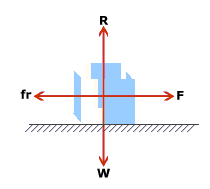 R is the reaction force because of the weight W. The external force is F and fr is the friction. F = -fr when no motion takes place.
Static friction is a kind of resistive force perceived in a body that is at rest. It is given as:
| Normal force | |
| Coefficient of static friction | |
| Static friction |
This formula will help us to compute the frictional force, co-efficient of friction or normal force in any asked numerically.
Kinetic friction
Kinetic friction is defined as a force that acts between moving surfaces. A body moving on the surface experiences a force in the opposite direction of its movement. The magnitude of the force will depend on the coefficient of kinetic friction between the two materials.
Friction is easily defined as the force that holds back a sliding object. Kinetic friction is a part of everything and it interferes motion of two or more objects. The force acts in the opposite direction to the way an object wants to slide. If a car has to stop, we apply brakes and that is exactly where the friction comes into play. While walking, when one wants to suddenly come to a halt, friction is to thank again. But when we have to stop in the middle of a puddle, things get harder since friction is less there and cannot aid one so much.
The coefficient of kinetic friction is assigned the Greek letter "mu" (μ), with a subscript "k". The force of kinetic friction is μk times the normal force on an object and is expressed in units of Newtons (N).
the force of kinetic friction = (coefficient of kinetic friction)(normal force)
Fk = μk η
Fk = force of kinetic friction
μk = coefficient of kinetic friction
η = normal force (Greek letter "eta")
Rolling friction
For a moving solid body, there are two principal types of friction that act upon it:
- The force resisting the motion of a rolling body on a surface is known as rolling friction or rolling resistance. The Rolling of a ball or wheel on the ground is an example of Rolling friction.
- The other type of friction is sliding friction. In this type of friction, there is a restriction on the body’s movement as only one side of the body is in contact with the surface. Pushing a box across the table is an example of Sliding friction.
Rolling friction is considerably weaker than sliding friction.
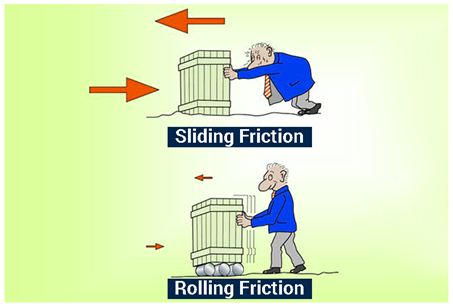
Laws of Rolling Friction
There are three laws of rolling friction:
- With the increase in smoothness, the force of rolling friction decreases.
- Rolling friction is expressed as a product of load and constant to the fractional power.
F = kLn - Rolling friction force is directly proportional to load and inversely proportional to the radius of curvature.
“Coefficient of Rolling Friction is the ratio of the force of rolling friction to the total weight of the object.”
In empirical terms, the coefficient of rolling resistance can be expressed as:
where,
- is the resistive force of rolling resistance
- is the coefficient of rolling resistance
- is the weight of the rolling body
Sliding friction
The resistance created will be equal to the force applied but will operate in the opposite direction.
Sliding Friction Formula
The formula for sliding friction is FS = μSFn
Where,
FS is the force of sliding friction.
μS is the coefficient of sliding friction.
Fn is the normal force.
Fluid friction
Fluid friction is the force that resists motion either within the fluid itself or of another medium moving through the fluid. There is internal friction, which is a result of the interactions between molecules of the fluid, and there is external friction, which refers to how a fluid interacts with other matter.
Fluid Friction is the force that hinders the flow of a fluid. The surface of the fluid offers resistance to the flow. In order to calculate Fluid Friction, the Fanning friction factor has to be calculated.
When an object moves through a fluid with velocity v, presenting area A to the fluid, the molecules that bounce off the object transfer momentum to the object at rate Δp/Δt = F, where F is the resulting drag force.
The formula for sliding friction is FS = μSFn
Where,
FS is the force of sliding friction.
μS is the coefficient of sliding friction.
Fn is the normal force.
Comments